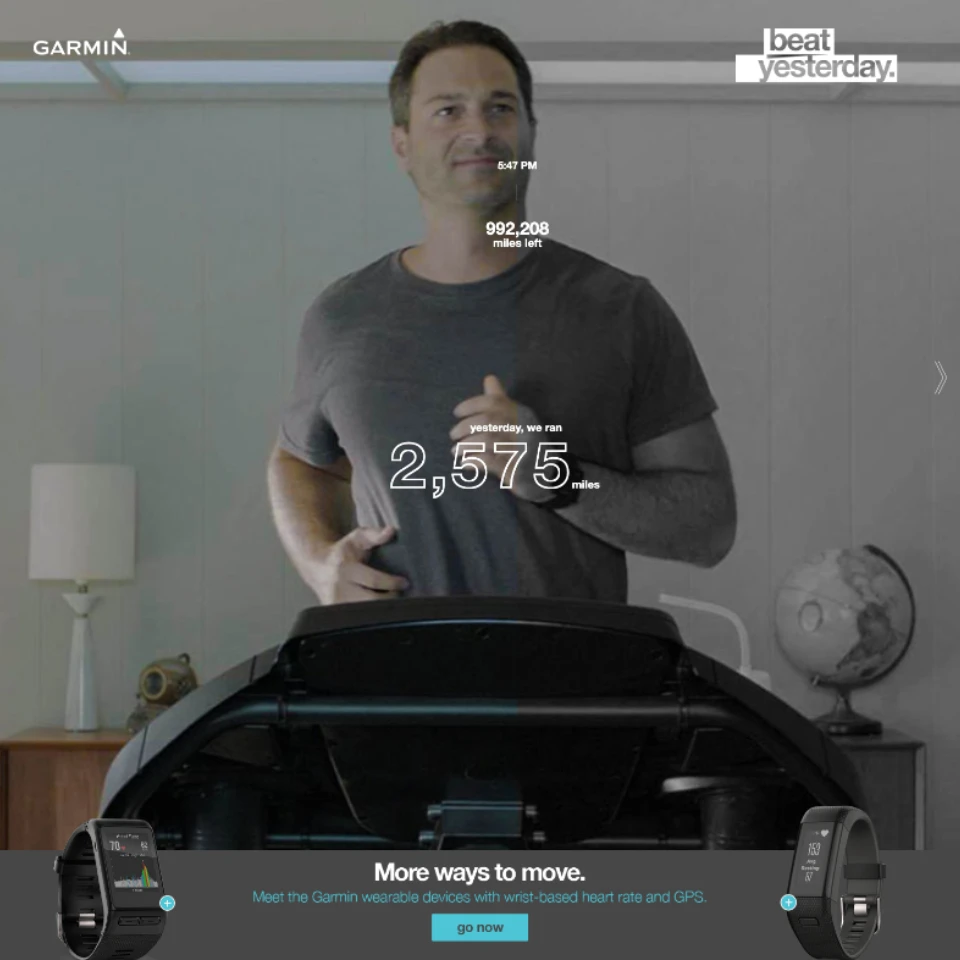
The Garmin vívoactive Page Grabber was an OMMA 2017 finalist in Rich Display Media. The unit is a full-page takeover that drops the GPS smartwatch into the page and lands a fellow fitness fan's distance over the past 24 hours.
The unit had to carry a live Garmin activity feed on the face, hold the drop-in and overlay motion, and still clear the ad-serving file-size limit.
How we built it
I took Garmin's creative assets and componentized them for a Page Grabber that had to carry a live feed and this motion system. Componentizing meant the face, the color and black-and-white states, and the overlay that crosses them stayed separate pieces rather than one baked comp, so live numbers could land on the face without re-cutting the motion. I owned wiring the feed into the face and packing the unit to serve. The feed came from Garmin's activity API, which pulled averages across the sports we were showing so the metrics landed on the face at the mark for that time of day.
Animation ran on GreenSock with CSS3 layered in, color and black-and-white states crossing under a shared overlay at different page lengths. Daniel Englert, my manager, owned a lot of the motion judgment on the unit, and I applied what I picked up from him on animation and motion design in the same sitting. I was his first hire, and for a stretch the two of us were the only creative developers at Undertone, sitting next to each other and hand-coding formats from scratch before productizing them onto the ad serving platform, so a lot of the process was ours to invent.
When the hard file-size limit blocked what the unit needed, the loop widened to three. Crow, lead engineer and architect, expanded the limit and put the standards into the framework, which moved the constraint off the creative and onto the platform. I pushed to experiment further while he held what the platform could safely serve.
What transferred
The part that carries to later projects is the mental model, especially how we laid out a shared file system and directory for this kind of unit. Delivery itself stayed manual at the time. We passed zips back and forth and packed files down under the weight limit while we worked out where automation would help.
Later builds started from that directory and handoff shape instead of re-deriving both per campaign.